 Bestå
Bestå
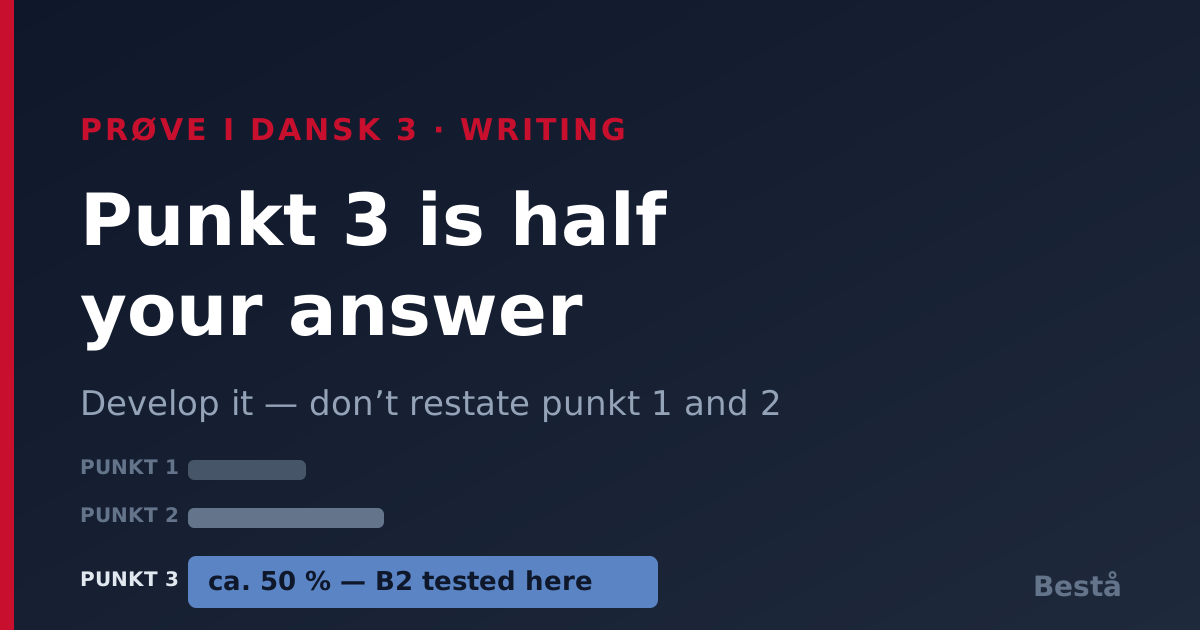
Most PD3 candidates prepare Delprøve 2 as three equal jobs: describe something, explain something, then give an opinion. That is not how it is marked. The official Bedømmelsesvejledning is unusually direct about it:
"Besvarelsen af delprøve 2 er afgørende for den endelige karakter, især punkt 3, der udgør ca. 50 % af den samlede besvarelse, og hvor prøvedeltageren udfordres på B2-niveauet."
— Bedømmelsesvejledning, skriftlig del af Prøve i Dansk 3, Maj 2025
Read that twice. Punkt 3 is about half your answer, and it is the specific place where B2 is tested. Punkt 1 and punkt 2 are the run-up. If you are splitting your time in three, you are under-writing the only part that carries the grade.
What punkt 3 actually asks
Whichever task you pick, punkt 3 is the same job wearing different clothes:
- Opgave A — Hvilke fordele og ulemper mener du…? Begrund dine synspunkter.
- Opgave B — Vurdér… Begrund dine synspunkter.
Punkt 1 asks you to describe. Punkt 2 asks you to explain or comment. Punkt 3 asks you to take a position and defend it. Those are different language acts, and only the third one requires the vocabulary and syntax that B2 is defined by.
The assessment criteria say the same thing at every grade band, with one word changing:
| Grade | What the guide says about punkt 3 |
|---|---|
| 12 | Views, standpoints and arguments are expressed "klart og præcist" |
| 7 | "overvejende klart og præcist", but with "forenklede begrundelser" |
| 02 | "kun i mindre grad klart og præcist", with "forenklede og uklare begrundelser" |
Notice what is being graded. Not how many opinions you have. The quality of your begrundelse — your reasoning. That is the whole ladder.
1. Decide. Do not survey.
This is the single most common way punkt 3 fails, and the assessment guide catches it explicitly. In its worked example of an answer graded 02, the examiners' criticism of punkt 3 is not about grammar:
"I punkt 3 forholder prøvedeltager sig ikke til, om det er de personlige eller faglige kvalifikationer, der er vigtigst."
The candidate had opinions. They wrote fluently about leadership. They simply never answered the question that was asked — which of the two matters more. They surveyed the topic instead of deciding.
If punkt 3 says vurdér, there is a verdict to deliver. If it asks fordele og ulemper, you still owe a position at the end — the task says begrund dine synspunkter, not list synspunkter.
The habit: before you write punkt 3, finish this sentence on your question paper — "Jeg mener, at ___, fordi ___." If you cannot finish it, you are not ready to write the paragraph.
2. Build reasoning in four moves
A begrundelse that reads as "simplified" is usually a claim with nothing behind it. Develop each argument in four steps:
- Påstand — the claim. "Jeg mener, at fleksible arbejdstider betyder mest."
- Begrundelse — why, with a fordi / da clause. "…fordi det giver medarbejderne mulighed for at tilpasse arbejdet til deres familieliv."
- Eksempel eller uddybning — make it concrete. "Fx kan en småbørnsforælder møde tidligt og hente sit barn om eftermiddagen."
- Konsekvens — the so-what. "Det reducerer stress og gør, at færre siger op."
Two arguments developed through all four moves beat five bare assertions, every time. The guide's word for the failure mode is "ikke udfoldede" — not unfolded. Four moves is what unfolding looks like.
3. Stop restating punkt 1 and punkt 2
The 02-band description names this directly as a trait of weak answers: "der kan være gentagelser fra punkt 1." It is an easy trap, because your earlier material is right there and it feels like continuity.
The fix is to change what you do with that material rather than repeat it:
- Punkt 1 gave you a case. In punkt 3, use it as evidence for a claim, in one clause — not as a retold story.
- Punkt 2 gave you causes or comments. In punkt 3, turn one into a reason your position is right.
Compare:
- ❌ "Som jeg skrev, tilbyder min arbejdsplads fitness i arbejdstiden." — repetition.
- ✅ "Netop fordi tilbuddet lå i arbejdstiden, benyttede næsten alle sig af det — og det er derfor, jeg mener, at placeringen betyder mere end selve aktiviteten." — the same fact, now doing work.
The test is simple: every sentence in punkt 3 should be pushing your position forward. If a sentence would sit equally well in punkt 1, cut it or convert it.
4. Nuance is what separates a good answer from a top one
Here is the examiners' comment on punkt 3 in the answer they graded 12:
"Prøvedeltager argumenter særdeles godt i punkt 3, idet prøvedeltager både kan begrunde, argumentere og nuancere med relevante eksempler … men også afslutningsvist sammenfatte sin vurdering med et overordnet argument."
Three verbs, then a fourth move: begrunde, argumentere, nuancere — and then pull it together with one overarching argument at the end.
Nuancere is the one candidates skip. It means acknowledging the other side and still holding your position:
"Det er naturligvis også vigtigt, at lederen har gode faglige kvalifikationer. Jeg mener alligevel, at de personlige vejer tungest, fordi faglige mangler kan kompenseres af dygtige kolleger — mens personlige kvalifikationer ikke kan erstattes."
That is a concession followed by a reason it does not change the conclusion. It is also, not coincidentally, where the complex syntax lives: subordinate clauses, contrast markers, lower-frequency vocabulary. Conceding a point is the cheapest way to demonstrate B2 syntax, because the sentence structure comes free with the idea.
5. Give it the space it needs — and do not bolt on an essay frame
If punkt 3 is half the answer, then roughly half your words belong there — whatever your total ends up being. Plan the paragraph count accordingly: punkt 1 short, punkt 2 medium, punkt 3 developed across two paragraphs if you need them.
Two warnings from the assessment guide about structure:
- A general introduction before punkt 1, or a general conclusion after punkt 3, can cost you marks if it floats free of the rest. The guide says examiners judge "alt efter hvor løsrevne afsnittene er" whether to deduct. A summary that genuinely gathers up your punkt 3 argument is good; a generic "Alt i alt er dette et vigtigt emne i dagens samfund" is not. In the 02 example the ending was judged "påklistret" — stuck on.
- Answering lopsidedly hurts. Writing "indholdsmæssigt skævt i forhold til den stillede opgave" is called out as pulling the grade down. An enormous punkt 1 and a thin punkt 3 is exactly that shape.
On length: the task sets a minimum of 200 words, but this is a rettesnor — guidance for you. Examiners are told explicitly not to count words, and only a serious deviation counts against you. Write to answer the task properly and the length follows.
6. Do not throw away Delprøve 1
Worth knowing, because it changes how you spend your last ten minutes: the guide says Delprøve 1 works as a tie-breaker. When examiners are torn between two adjacent grades — say 02 and 4 — a good e-mail argues for the higher one and a weak one pulls down.
So punkt 3 is where the grade is won, but the e-mail is where a borderline grade is settled. Do not leave it half-proofread.
Common mistakes
- Listing advantages and disadvantages and never choosing. The most common failure, and the one the guide's 02 example is built on.
- Equal thirds. Three paragraphs of similar length means punkt 3 is roughly half the size it should be.
- Repeating punkt 1 in punkt 3 instead of using it as evidence.
- Claims with no fordi. An opinion without reasoning is what "forenklede begrundelser" means.
- A generic opening and closing that could sit on any topic.
- Counting to 200 and stopping mid-argument. The minimum is not the target.
- No concession. Never acknowledging the other side caps how nuanced you can look.
A phrase bank for punkt 3
Stating your position
- Efter min vurdering… · Jeg mener, at… · Det er min klare holdning, at… · Hvis jeg skal vælge, vejer … tungest
Giving reasons
- …fordi… · …da… · Det skyldes, at… · Grunden er, at… · Det hænger sammen med, at…
Making it concrete
- Et konkret eksempel er… · Fx kan man forestille sig, at… · Det ses tydeligt, når…
Conceding, then holding your line (the nuance move)
- Det er naturligvis også vigtigt, at… · Man kan indvende, at… · Omvendt kan det være et problem, at… · Jeg mener alligevel, at… · Det ændrer dog ikke ved, at…
Weighing up
- På den ene side… på den anden side… · Fordelene vejer efter min mening tungere end ulemperne · Set i det lange løb…
Landing the conclusion
- Samlet set mener jeg, at… · Alt i alt taler mest for, at… · Derfor er min konklusion, at…
Drill the concession group hardest. It is the shortest route to the syntax the top band describes.
Related guides
- PD3 Skriftlig Opgave — the writing exam guide — the e-mail task, Opgave A vs B, and how the written part is graded.
- PD3 writing: Opgave A walkthrough — punkt 3 in a diagram task, worked end to end.
- PD3 writing: Opgave B on sundhedstilbud — the same treatment for the experience-based option.
- PD3 Delprøve 1: the e-mail — the tie-breaker task, done properly.
- PD3 grades and pass mark — how writing is weighted in your final result.
Practise punkt 3 in Bestå
Write your own answer to a PD3-format Delprøve 2 task against the clock, then get feedback on structure, argumentation, grammar and vocabulary — graded on the official 00–12 scale. The feedback tells you whether your punkt 3 actually developed a position or only listed one. Download free on iOS and Android.