 Bestå
Bestå
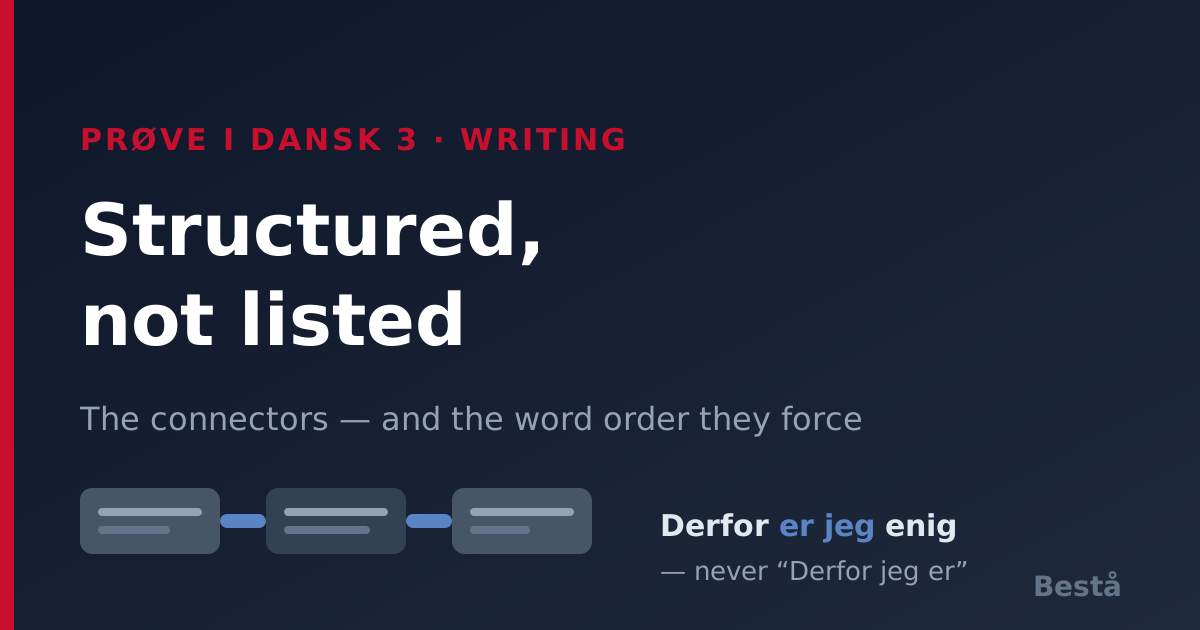
Two candidates write the same ideas in the same Danish. One text reads as an argument. The other reads as a list of true statements. The difference is almost never vocabulary — both know desuden and derfor. The difference is that one of them can front a connector without breaking the sentence, and the other cannot, so they stop trying.
That is the part nobody tells you: in Danish, a connector at the start of a sentence costs you a verb. Derfor does not simply attach to the front of your sentence — it takes first position, which pushes the verb ahead of the subject. Get that wrong and you have traded a vocabulary win for a grammar error. Sense that risk and avoid it, and you produce short, unconnected, subject-first sentences: a list.
This is not a hunch. A 2025 study of 217 Danish learners found that when the subject was not in first position — exactly what a fronted connector causes — a quarter of sentences came out with the wrong word order. When the thing in first position was a whole subordinate clause, accuracy fell further still.
So: learn the connectors with the word order they force. That is the whole skill.
The one box worth memorising
Here is a single idea, written three ways. Same meaning. Three different word orders.
| Jeg var træt, men jeg blev færdig. | men → subject stays first |
| Jeg var træt. Alligevel blev jeg færdig. | alligevel → verb before subject |
| Selvom jeg var træt, blev jeg færdig. | selvom → subordinate clause, then the main clause inverts |
If you can produce all three on demand, you can write a structured PD3 text. Most candidates can only produce the first, which is why their writing plateaus.
1. Family one: the words that change nothing
Sideordnende konjunktioner: og · men · eller · for · så
These sit outside the clause. They do not take first position, so the subject stays exactly where it was. No inversion, ever.
"Jeg er enig i forslaget, men jeg mener, at det er for dyrt."
"Undersøgelsen er ny, og den viser noget overraskende."
This is the safe family. It is also the reason so many texts read flat — og and men are all a nervous candidate uses, and they carry only two of the four relationships you need.
One trap: så belongs to two families. As a linking conjunction it behaves like the ones above — "Han var syg, så han blev hjemme." But Så at the start of a new sentence is an adverb, and then it inverts: "Så gik han hjem."
2. Family two: the words that move your verb
Konjunktionaladverbier: derfor · desuden · derudover · dermed · alligevel · derimod · til gengæld · imidlertid · således · samtidig · ikke desto mindre
These are real sentence elements. Put one at the front and it occupies first position — so the finite verb comes next, and the subject moves in behind it.
✗ "Derfor jeg er enig." → ✓ "Derfor er jeg enig."
✗ "Desuden undersøgelsen viser…" → ✓ "Desuden viser undersøgelsen…"
✗ "Til gengæld der er også ulemper." → ✓ "Til gengæld er der også ulemper."
The habit: every time you write one of these at the start of a sentence, say the verb immediately after it, before you think about the subject. Derfor er…, Desuden viser…, Alligevel mener…. Train the pair, not the word.
Note that dog prefers to sit inside the clause rather than at the front: "Jeg er dog ikke helt enig." That is native placement, and it is an easy point to pick up.
3. Family three: the clause-builders
Underordnende konjunktioner: fordi · da · selvom · hvis · når · mens · at
These do something bigger: they build a subordinate clause. Two consequences, and both are heavily marked.
Inside the subordinate clause, adverbs go before the verb. This is the single most visible B2 marker in Danish writing.
✗ "…fordi jeg er ikke enig." → ✓ "…fordi jeg ikke er enig."
✗ "…selvom man har aldrig prøvet det." → ✓ "…selvom man aldrig har prøvet det."
If you put the subordinate clause first, the main clause inverts. The whole clause counts as first position, so the main verb comes straight after the comma.
✓ "Hvis man ser på tallene, er billedet et andet."
✓ "Selvom mange er enige, er der stadig kritik."
✓ "Når man bor langt væk, betyder kontakten endnu mere."
This is the construction the research found hardest — and it is also the one that most makes a text read as considered rather than assembled. Worth drilling on its own.
4. Four jobs, not one — this is what "listed" really means
A text reads as a list when every connector does the same job: addition. Og… også… desuden… derudover… Ideas accumulate, but nothing is weighed against anything.
Structured writing uses four relationships:
- Tilføjelse (addition) — desuden, derudover, samtidig
- Modsætning (contrast) — derimod, til gengæld, omvendt, på den anden side
- Årsag og konsekvens (cause and effect) — fordi, derfor, dermed, af den grund
- Indrømmelse (concession) — selvom, alligevel, ikke desto mindre
Look at your last practice text and label each connector. If they are all addition, that is the diagnosis, and it is fixable in one draft.
Here is the same content, listed and then structured:
Listed: "Mange unge bruger sociale medier. Det kan være et problem. Det kan også være en fordel. Man kan holde kontakt med venner. Man kan også blive afhængig. Jeg synes, det er vigtigt at finde en balance."
Structured: "Mange unge bruger sociale medier dagligt, og det har både fordele og ulemper. På den ene side er det nemt at holde kontakt med venner og familie, selvom man bor langt fra hinanden. På den anden side kan et højt forbrug føre til afhængighed. Derfor mener jeg, at balancen er det afgørende — ikke medierne i sig selv."
Same ideas. Same level of vocabulary. The second one argues.
5. Concession is the move that reads as B2
If you add one thing to your writing before the exam, make it concession: conceding a point and then answering it. It is what begrund dine synspunkter is actually asking for, and it is the clearest signal that you can hold two ideas at once.
Three reliable shapes:
"Det er rigtigt, at det koster mange penge, men efter min vurdering er gevinsten større."
"Selvom der er gode grunde til at være skeptisk, mener jeg alligevel, at…"
"På den ene side… På den anden side… Alt i alt vejer fordelene tungest."
Notice that all three end with your position. Concession without a conclusion just reads as indecision.
6. Don't front everything
Having learned to front connectors, the next failure is fronting one on every single sentence. That reads as mechanical, and it flattens the emphasis — if everything is signposted, nothing stands out.
Two guidelines that work:
- One connector per paragraph should be doing structural work — marking the turn in the argument. The rest can be inside the sentence, or absent.
- Vary the position. "Der er dog en anden side af sagen" and "Dette hænger formentlig sammen med…" connect just as well without fronting an adverb.
Also match the register to the task. Imidlertid and ikke desto mindre are formal, and they fit a discussion text. In the personal e-mail of Delprøve 1 they sound stilted — write men, så, derfor, til gengæld to a friend.
Common mistakes
- V3 after a fronted connector — "Derfor jeg mener…". The most common error in the whole paper, and entirely mechanical to fix.
- Treating men like derfor — "Men er jeg enig". They mean similar things and behave completely differently.
- ikke after the verb in a subordinate clause — "fordi jeg er ikke enig".
- Forgetting the main clause inverts after a fronted hvis/selvom/når clause.
- Addition-only connectors, producing a list of true statements with no argument.
- A connector on every sentence, which reads as a template rather than a text.
- Formal connectors in the informal task — imidlertid in a friendly e-mail.
Phrase bank
Tilføjelse — desuden · derudover · endvidere · samtidig · ligeledes · for det første… for det andet…
Modsætning — men · derimod · til gengæld · omvendt · på den ene side… på den anden side · imidlertid
Årsag og konsekvens — fordi · da · derfor · dermed · af den grund · som følge heraf
Indrømmelse — selvom · alligevel · ikke desto mindre · det er rigtigt, at… men…
Eksempler — for eksempel · blandt andet · såsom · herunder
Din vurdering — efter min vurdering · det afgørende er, at… · alt i alt · samlet set · kort sagt
Drill these as connector + verb pairs, not as single words: derfor er, desuden viser, alligevel mener, til gengæld er. That is the pairing that survives exam pressure.
Related guides
- PD3 Skriftlig Opgave — the writing exam guide — the two tasks, the timing, and how the written part is graded.
- PD3 writing: Delprøve 1, the personal e-mail — where the informal connectors belong.
- PD3 writing: Opgave B on sundhedstilbud — a full walkthrough of a discussion task, where concession earns its keep.
- 7 mistakes that fail PD3 candidates — the structural errors censors mark against.
Practise PD3 writing in Bestå
Write a PD3-format answer against the clock, then get feedback on structure, argumentation, grammar and vocabulary — including word order — graded on the official 00–12 scale. Download free on iOS and Android.