 Bestå
Bestå
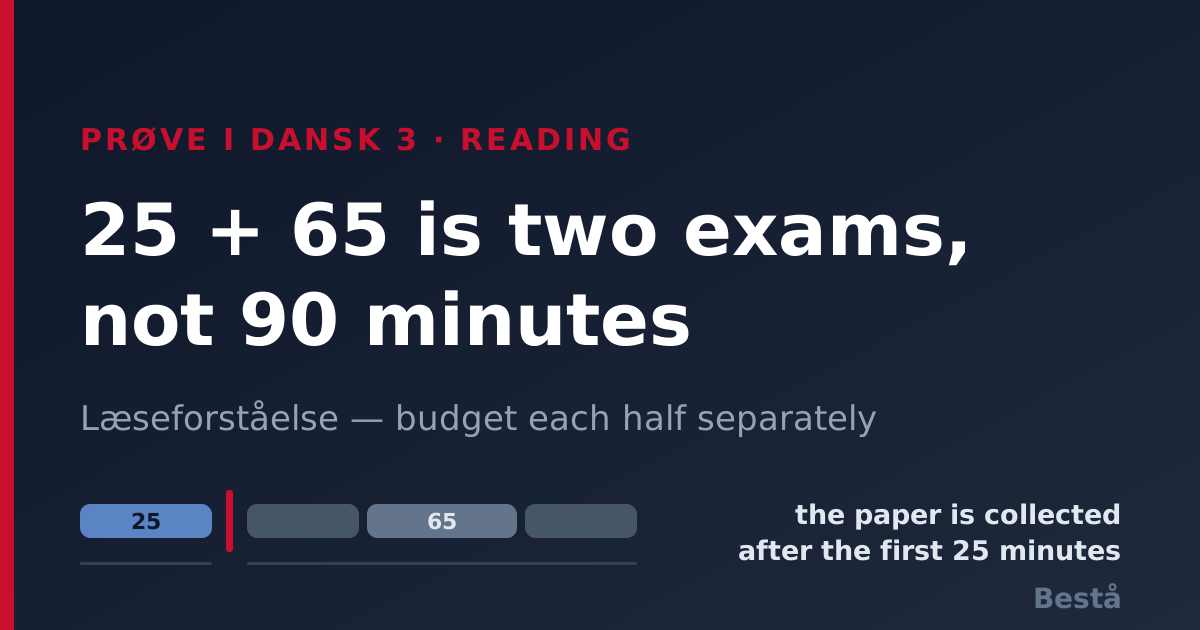
Almost everyone preparing for PD3 læseforståelse learns the same number: 90 minutes. It is the wrong number to carry into the room. The 90 minutes are split 25 + 65, and the split is not a suggestion about pacing — it is a hard stop. Delprøve 1 gets its own 25 minutes, and then that paper is collected. Whatever you did not answer is gone. You cannot borrow a minute from the 65 that follow, and you cannot go back at the end "if there's time".
So PD3 reading is two exams back to back, not one 90-minute exam. Candidates who plan it as 90 continuous minutes make the same mistake in both directions: they drift in delprøve 1 because it feels like there is a long session ahead, and then they arrive at the 65 minutes with no plan for how to divide them. Both halves need their own clock. Here is how to set them.
The format, in the shape the clock actually takes
The PD3 exam reading section is four tasks across two sittings:
Sitting one — 25 minutes
- Delprøve 1 — a collection of informative texts, around 10 standard pages, and 15 factual questions with short answers. Then the paper is collected.
Sitting two — 65 minutes, which you manage yourself
- Delprøve 2A — an informative or argumentative text of about 1.5 pages, 3 multiple-choice questions, three options each, in the order the text handles them.
- Delprøve 2B — a longer text, about 2.5 pages, with 5 passages removed for you to put back. You are offered more options than gaps, so two of them fit nowhere.
- Delprøve 3 — about 1.5 pages with 8 words or expressions removed, four options for each.
No aids are permitted in læseforståelse — no dictionary, on paper or otherwise. That matters for your clock more than people expect: there is no lookup to fall back on, so a word you do not know is a decision to make immediately, not a task to defer.
1. Delprøve 1 is a sprint with a wall at the end — plan backwards from the wall
Twenty-five minutes, 15 questions. That is well under two minutes per question including the time to find the right text in the collection, and the collection is deliberately longer than you can read.
The tactical consequence is simple: plan to reach question 15, not to perfect question 1. A blank answer scores nothing, and there is no partial credit for having read carefully. Set yourself a checkpoint: after 12 minutes you should be at question 8 or past it. If you are on question 4, you are not reading too slowly, you are reading the wrong way, and the fix is to stop reading texts and start searching them.
When a question resists, leave it, mark it, and move. Thirty seconds of staring costs you a question you could have answered in twenty.
2. The 65 minutes are yours — which means nobody else will divide them
This is the half most people arrive at with no plan, and it is where the harder marks live. The three remaining tasks are not equal in weight or in difficulty, so an even three-way split is the wrong instinct. A workable division of the 65:
- Delprøve 2A — give yourself 15 minutes. Three questions, and the text is short. The cost here is re-reading the whole text for each question instead of using the fact that the questions follow the text's own order.
- Delprøve 2B — budget 25 minutes. This is the longest text and the slowest task, because every one of the five choices has to be tested against what comes before and after the gap. It is also where an even split quietly starves you.
- Delprøve 3 — give yourself 15 minutes. Eight items, four options each. It moves fast once you know the text's argument, and it is the task most likely to be rushed into guesses if the earlier two overran.
- A final sweep — set aside 10 minutes. Not spare time. Time with a job: fill every blank, check the two 2B options you rejected, and re-read the one item you flagged.
Write the clock times down. Before you start, convert the budget into actual times on your watch — 2A until 10:15, 2B until 10:40, and so on. Under pressure people track elapsed time badly and always in the optimistic direction; a target time is a fact you can check in a second, and a rough sense of "how long has this been" is not.
3. Spend the handover deliberately
There is a seam between the two sittings while papers are collected and the next ones handed out. Candidates typically spend it replaying delprøve 1 — did I get number 11? That is the single least useful thought available, because delprøve 1 is now unchangeable and the questions with actual marks left in them are on the desk in front of you.
Use the seam for one thing: reset the clock. Note your finish time for each of the three remaining tasks. Then start 2A by reading the questions first. Going in with a division already decided is the difference between managing 65 minutes and being managed by them.
4. Triage rules, decided now rather than at minute 55
You will sometimes fall behind. The mistake is deciding what to sacrifice while panicking, because under pressure everyone sacrifices the same thing — the last task — and the last task is eight quick marks.
Fix the rules in advance:
- If 2B is overrunning, stop it at your target time anyway. Place your best remaining option in each empty gap and move on. Delprøve 3 has eight items and moves quickly; trading it for two more minutes of deliberation on one gap is a bad exchange.
- Never leave a blank. Nothing is deducted for a wrong choice on a multiple-choice item. An unanswered gap is a guaranteed zero; a guess between two survivors is a coin flip you are already better than, because eliminating even one option puts the odds in your favour.
- Answer 2B's easy gaps first. The five gaps are not equally hard. Placing the two you are sure of removes two options from every remaining decision and makes the rest smaller.
- A word you do not know is not a stop sign. With no dictionary, decide from the sentence around it and go. The exam is testing whether you follow the argument, and you can follow an argument through a word you cannot translate.
5. Practise the clock, not only the Danish
Most preparation is untimed — texts read at home at reading pace, answers checked afterwards. That trains comprehension and leaves the actual failure mode untouched.
Train the halves separately, the way the exam runs them:
- Do delprøve-1 sets as standalone 25-minute drills with a timer you cannot pause, and mark yourself on how many of the 15 you reached — not only on how many were right. Reaching 14 with 11 correct beats a perfect 9.
- Do the other three as a single 65-minute block, in order, with your split written down before you start. Practising them as three separate tasks never rehearses the decision that actually costs marks: when to abandon 2B.
- After each block, look at the clock before the answers. Where did the time go, and which task paid for it?
Common mistakes
- Treating 90 minutes as one budget. The paper is collected after 25; the two halves cannot subsidise each other.
- Reading delprøve 1 rather than searching it. The collection is longer than the time on purpose.
- Splitting the 65 evenly. 2B is slower than 2A and delprøve 3 combined at their honest pace.
- Leaving the last task to whatever remains. Delprøve 3 is eight marks that fall fast when rushed.
- Blanks. No penalty for a wrong pick — a blank is worse than a guess, always.
- Perfecting one item. The marginal minute is always worth more on an unanswered question than on a nearly-certain one.
Danish phrase bank — the clock words on the paper and in the room
You lose time when you re-read an instruction you half-recognise. Learn these to the point of not thinking about them.
The rubric and the invigilator
- "Delprøve 1 varer 25 minutter." — Delprøve 1 lasts 25 minutes.
- "Der er ingen hjælpemidler tilladt." — No aids are permitted.
- "Besvarelsen afleveres, når tiden er gået." — The answer sheet is handed in when time is up.
- "Du må ikke bladre videre endnu." — Do not turn the page yet.
- "Der er ti minutter tilbage." — There are ten minutes left.
- "Skriv dit svar på svararket." — Write your answer on the answer sheet.
The instructions to each task
- "Svar kort på spørgsmålene." — Answer the questions briefly.
- "Brug indholdsfortegnelsen." — Use the table of contents.
- "Sæt kryds ved det rigtige svar." — Mark the correct answer.
- "Kun ét svar er rigtigt." — Only one answer is correct.
- "To af mulighederne skal ikke bruges." — Two of the options are not to be used.
- "Indsæt det ord, der passer bedst." — Insert the word that fits best.
Telling yourself to move on — worth having in Danish, because thinking in Danish is faster than translating mid-exam
- "Videre — jeg vender tilbage." — Move on, I'll come back.
- "Gæt kvalificeret, og gå videre." — Make an educated guess and move on.
- "Ingen felter må stå tomme." — No boxes may be left empty.
Related guides
- PD3 Reading: How to Approach Every Task and Score Full Marks — the method for each of the four tasks, once the clock is under control.
- 7 Mistakes That Fail People at PD3 — running out of time is two of them.
- How to Pass Prøve i Dansk 3 — the whole exam, all four skills.
- PD3 Writing Delprøve 1: the email task — the other half of the written day, and its own clock.
Practise the split in Bestå
Bestå has PD3-format reading sets for all four task types, with instant answer checking and a built-in translator for afterwards — so you can run a 25-minute delprøve-1 drill and a 65-minute block the way the exam runs them, then see exactly where the time went. Written tasks are graded on the official 00–12 scale with feedback on structure, argumentation, grammar and vocabulary.
Held og lykke med prøven!