 Bestå
Bestå
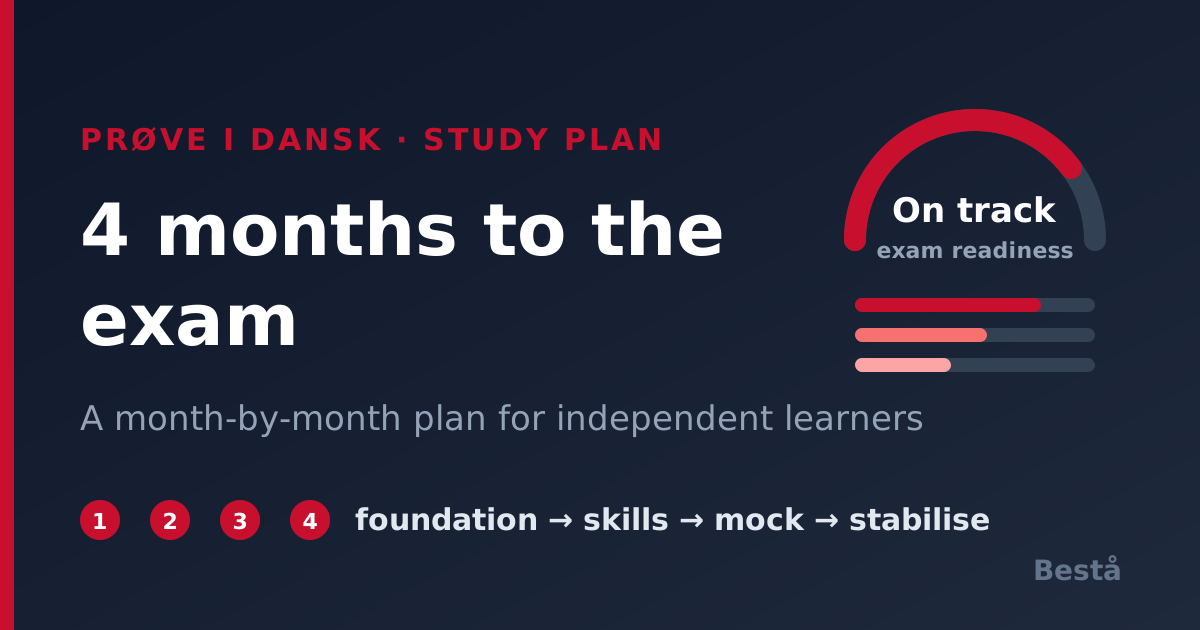
The exam is roughly four months away, and you are starting to feel it. Maybe you signed up for the November–December Prøve i Dansk without a plan. Maybe you have been "meaning to start" for weeks. If you are studying on your own, without a class or a teacher to keep you on track, that quiet panic is normal — and it is actually good news. Four months is enough time to prepare properly, as long as you use it deliberately instead of cramming at the end.
This guide gives you a structure: how to divide the four months, how to study each week, and how to tell whether you are on track. It works for both Prøve i Dansk 2 and Prøve i Dansk 3, because the plan is the same. Only the difficulty of the tasks changes.
Why independent learners struggle — and how a plan fixes it
When you study in a class, someone else provides the structure. There is a schedule, a deadline every week, and a teacher who tells you what to work on next. When you study alone, all of that is on you. The two things that go wrong are almost always the same: you have no fixed routine, so practice happens sporadically, and you have no feedback, so you cannot see whether you are improving.
A plan solves the first problem. A feedback loop solves the second. You do not need a complicated system — you need a small, repeatable weekly rhythm that you can actually keep for four months, plus a way to check your progress so the panic turns into evidence.
Step 0: Take one baseline test this week
Before you plan anything, find out where you stand. Do one realistic reading task under time pressure, write one full answer, and — if you can — record yourself speaking on a topic for two minutes. Do not study first. The point is an honest snapshot.
You are looking for one thing: where do you lose the most points right now? If you read well but write imprecisely, writing gets more of your time. If you write fine but freeze when speaking, no amount of extra reading will save you. The best plan is not the most complete one — it is the one aimed at your weakest section. For a breakdown of what each section tests, see the PD2 exam overview or the PD3 exam overview.
The four months, month by month
Think of the four months as four phases. Each has one job. Do not try to do everything at once.
Month 1 — Foundation and format
Your only goal this month is to make the exam stop being a mystery, and to build the daily habit. Learn the exact structure of your exam: how many reading tasks, how long the written part is, what the oral exam actually asks of you. Every hour you spend now on understanding the format saves you energy later, because you will stop wasting attention on "what is this task asking?" and spend it on the Danish itself.
Do short sessions — 20 to 30 minutes, almost every day. Consistency matters far more than length this month. You are training the habit as much as the language.
Month 2 — Targeted skill building
Now you attack your weakest section from the baseline test, without neglecting the others. This is the month for volume: lots of realistic tasks, in their real form. For reading, that means working through task types until the format is automatic — the PD2 reading masterclass shows the exact approach for each one. For writing, it means practising structure and language control, not chasing fancy words; the PD2 written production guide has a structure that works. For speaking, it means talking out loud, not rehearsing in your head — see how to pass the PD3 oral exam.
Crucially, every task this month should end with the same question: why did I get that wrong? Vocabulary? Time pressure? A detail I overlooked? An answer that looked right? That analysis is where the improvement actually happens.
Month 3 — Exam simulation
This month you stop practising in fragments and start practising like the real thing. Time yourself on full reading sections. Write complete answers from start to finish, not just openings. Answer speaking topics out loud under a clock. The goal is to make the exam conditions — the pressure, the timing, the pace — feel familiar before the day itself.
This is also the month to lean hardest on feedback. If you have repeated the same grammatical mistake for weeks, more writing alone will not fix it. You need something or someone to point it out.
Month 4 — Stabilise and taper
The last month is not for learning new things. It is for stabilising what you already have. Do a couple of full mock exams under realistic conditions. Review your recurring mistakes one more time. Get "conservative in the good way": use phrasing you can control, drop the clever expressions you have only used once. On exam day, stability wins over ambition.
If you feel nervous in the final weeks, that is not a sign you are unprepared. The goal was never to remove the nerves — it was to build enough routine that they matter less.
How to study in a normal week
Inside every month, the weekly rhythm stays roughly the same. A plan you actually follow beats a perfect plan you abandon. For most independent learners with a job and a family, this works:
- 2 days reading — realistic tasks, timed once you reach Month 3.
- 2 days writing — full answers, always reviewed for mistakes.
- 2 days speaking — out loud, on real topics, ideally recorded.
- 1 day review — no new tasks. Reread your mistakes and repeat what still trips you up.
Twenty to thirty focused minutes on most days beats a three-hour marathon on Sunday. The exam does not only test knowledge; it tests routine, and routine is built in small, regular doses. If the only way you can study is sitting at a desk with plenty of free time, it usually will not happen — which is why practising on your phone, in short sessions, is the most realistic option for most people. Bestå is built for exactly that: free, exam-like reading, writing, and speaking practice on iOS and Android.
How to study well, not just often
Four principles separate learners who improve from learners who just stay busy:
- Practise in the exam's form. Grammar drills and word lists are not useless, but they should be trained through real task types, not in isolation.
- Always close the loop. Never mark an answer right or wrong and move on. Find the reason. Your recurring mistakes are your fastest points.
- Get feedback on writing and speaking. These are the two sections where you cannot reliably grade yourself.
- Repeat what you got wrong. Spaced repetition of your own mistakes beats endless new material.
How to know you are on track
The hardest part of studying alone is that you cannot see whether it is working. You put in the sessions, but four months feels long and the exam feels far away, so doubt creeps in. The fix is to make your progress visible to yourself.
Keep it simple. A single note on your phone is enough:
- Log your mistakes, not your scores. After each session, write the one or two things that went wrong — a missed negation, a tense you keep confusing, freezing on a speaking topic. When the same mistake stops reappearing, that is real progress you can see.
- Track coverage, not hours. Tick off each task type and each section as you practise it. By Month 3 you want no blank rows — every part trained in its real form at least a few times.
- Re-run your baseline monthly. Repeat the Step 0 test at the end of each month under the same conditions. Comparing month to month tells you far more than any single session, and watching your weakest section climb is the reassurance the plan is built to give you.
Progress you can point to turns "I hope I am on track" into "I can see I am on track" — which is exactly what an independent learner four months out needs most.
Related guides
- How to pass Prøve i Dansk 3 — the targeted-practice mindset behind this plan.
- PD2 Reading: score full marks — the Month 2 reading method, task by task.
- PD2 Written Production guide — a writing structure you can stabilise by Month 4.
- How to pass the PD3 oral exam — turning speaking into a trainable exam situation.
Start today, not next week
The plan only works if it starts. You do not need the perfect setup or a free Sunday — you need one baseline test this week and a 25-minute session tomorrow. Four months of small, regular practice will get you further than any last-minute sprint. Download Bestå free and do your first session today.